
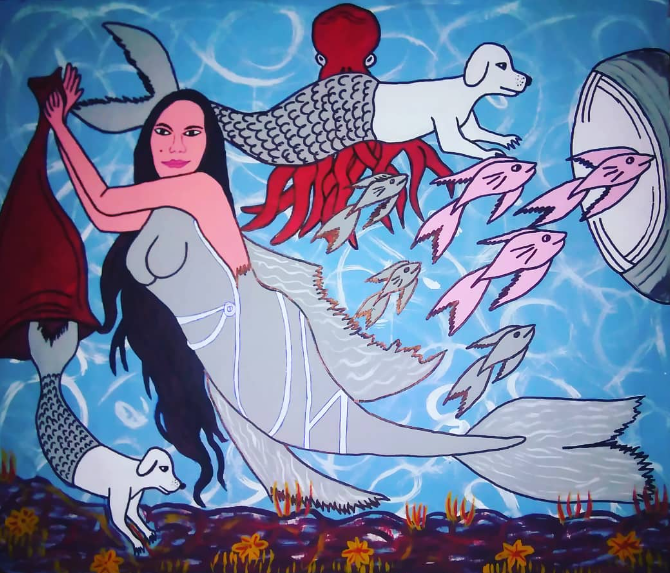
It was known that on a day that year there had been a certain discovery of texts in the village of X. The village, located on the border of the Ester Mountains, sees little activity compared to the neighboring towns and has remained relatively undisturbed by outsiders. It is a small village with a dwindling population mainly sustaining itself on pastoralism. Having had no real impact on the history of the area it had largely gone unnoticed by the world and seen as nothing but a tranquil little hamlet by neighboring towns.
In late March the discovery of the texts was made by a resident of the village. They had been found by a carpenter lodged inside the village church, an inconspicuous small chapel constructed in the late 18th century. Working on restorations of the altar, the carpenter had discovered the texts when he found a slight space behind the altar relief, a depiction of the local patron Saint Anne. Having been seemingly well hidden, the small breach seemed to have gone unnoticed until that point. Stashed into this small crevice was where the texts were found by the carpenter. Confounded at first, he thought of them to be nothing particular at first and without barely examining them they were discarded with the rest of the debris. However, after a restless night of dreams, the man who was of a devout disposition, decided to return the next day and retrieve them. When questioned about this later he claimed to have had a strange premonition in his dreams. It was a dark night, and he was standing in front of the sea (even though he had never witnessed it in his life before). In the pitch black night there was nothing to see except for the occasional flash of thunder. Then, suddenly, the thunder struck in the far horizon. Upon it, the sea briefly lit up, revealing a breathtaking sight. As if illuminated by the brief flash of light, the form of a woman became visible on the far horizon. Surely, she cannot have been of human nature (for she was far too great of shape to have been a person to be seen from that far away and her form was not tangible enough to be perceived) yet the carpenter had no doubt she was indeed a woman. Her form seemed to beckon him from afar. Without being able to take his eyes off of her, the man was compelled to enter the icy water, sending a shock of cold through his legs as he stepped in. He waded further and further until he was submerged completely in the cold darkness. Yet, the shape of the woman on the horizon shone brightly as a pyre, guiding him towards her. It was at that moment he woke up. Convinced that this had been a vision of Saint Anne he returned the next day and searched through the debris from the previous day, eventually finding the discarded papers.
Unfortunately, exposure to the elements had procured damages upon the material and as a result some of the pages were damaged beyond recognition, but the majority of it was still able to be read. The man initially brought the texts back home with him without notifying anyone of them. When asked about the reason for this later he only answered that he had felt compelled to hide them. He had thought that his dreams had been a sign that he had been chosen by Saint Anne, that whatever was written in those texts was meant for him alone.
The texts seem to consist of mainly poorly made copies of catholic missals and breviaries, primarily thought to be the product of a seminarian. While an accurate dating has yet to be produced, they are thought to have been written by the early 19th century at latest. The reason for these unremarkable texts to have been lodged behind the relief remain unknown, but some think it could’ve simply have been due to an accident. While the texts seem of little importance, apart from a rather aesthetical rendering of the Catechismus Romanus, there is one particular segment which stands out from the rest of the texts. It appears on the end of an unfinished copy of the hymn Pange Lingua. The remainder of the page contains what seems to be a cipher or perhaps a brief poem, written in upper German as opposed to latin.
“Submerged in the ocean of slumber
The plunged queen rests
Dreaming up her own form
Fated to be
Her breath precedes her birth
Exchange thine will for hers”
The meaning of the text remains disputable and it is thought to have been a later addition to the parchment. It is theorized that it may have some meaning related to Saint Anne, due to its description of a female subject, but most scholars dismiss it. Some people think that it might have an alchemical meaning, as it is known that there had briefly lived a priest in the village who had been known for his interest in alchemy before dying in an endemic. However, the most common theory is that it is the personal scribblings of either a priest or seminarian, to be taken to hold no greater meaning.
On the days following the finding of the texts, a series of strange happenings started to occur in the village. On the first night, there were reports of people seeing a strange light on the edge of the village. When sent to investigate the next day, officials found that the ground had been dug up and piled up on the side. It was not thought to be a reason for concern at first, but as the days passed the pile would only increase in volume and eventually it would seem that whoever had been doing it had started to form the pile into some sort of shape. The town’s council eventually started getting concerned about the bizarre occurrence and, fearing they could be dealing with some sort of plunderer or a person of deranged nature, they assigned some of the townsfolk to keep watch for the perpetrator. Some nights there would be a group of people guarding the site, however, after nights and nights of waiting they would return unsuccessful each time, not having been able to catch anyone. And then at the very night when they would give up they would once more awaken to the pile having grown, being more and more shaped into some grotesque figure that perhaps at the time would’ve not resembled a human more than a thicket of bushes might to the unimaginative eye. This process continued for weeks and then months and it eventually came to be a source of ghostly rumors in the village. People were saying that it could be the work of a secret cult, of people under demonic influences, or perhaps it was not even a feat of humans and instead the ground itself had moved by geographical forces somehow. However, most bizarre of all perhaps was that no one seemed to have the courage to destroy the strange statue. Perhaps it was fear of the unknown nature of this phenomena but there was not even a single attempt by anyone to dismantle it and so it kept on mysteriously being built, standing alone at the edge of the village as if dutifully watching over it. People had since long given up on trying to find who was causing all of this and as the months passed the statue would eventually come to seem to be near its completion, slowly starting to take the shape of a woman.
On the day of the summer solstice an emergency happened in the village. During the night a murder had occurred. It was a gruesome, yet perhaps by terms of intrinsicality it was a simple murder. A family had been killed. The bodies had their necks sliced open. What was more disturbing about the murder was that the bodies had been drained of blood, leaving behind a scene that was much to tidy for its circumstances. The town was immediately searched for the murderer, but it was not long until he was found. He had been careless, and one of the villagers had seen him outside of the family’s house on the eve of the murder. The man accused was none other than the carpenter who had found the texts himself. The man did not object to having his house searched and evidence of his guilt was quickly found. While the complete details are not known, what is certain is that he had indeed drained the bodies of their blood, and kept it stored in his dwelling. Yet the man had no qualms about being arrested and showed to particular distress for his situation. Perhaps he had accepted that he would be found? Or perhaps he felt it to be a gamble with fate? Whatever the case, the man did not resist and was calmly escorted away. When tried he was quickly found guilty of the murders. The trial was short and the man made no attempt to defend his actions, but admitted that it was he who had done it without a sign of remorse. When asked about his motives, the man calmly referred to the texts he had found in the chapel, over and over. “Someone would have had to do it. If not me then another… Perhaps it was only a mere chance I came across the scriptures, yet by no means was it less of a coincidence that it was I who was to fashion her. After all, by the time it was written it had already been decided, all of it. However, I realize now that it was perhaps not my destiny to finish her. No… perhaps that is for someone yet to come… Or someone that has already been. At any rate, it is of no matter to us. We are simply but specters of her dream that she is yet to be born into.”
When asked about why he had committed the murders the man simply stated:
“Because without blood running through her veins, how can she ever hope to move?”
It was a bizarre ritual. Fashioning a body from the elements he had seemingly tried to create a human out of nothing it seemed as. Indeed, it appeared to be an almost alchemical process he had attempted, as if he could’ve exchanged his will for another’s. But what had he been guided by? Something like fate? If so, then perhaps we are nothing but pawns to the ones who will it, for those who have already been breathed into existence long before they would take their first…
An attempt to demolish the statue was never made. Officials of the village proposed it, however, in the end the proposals were left unsigned and unenacted in favor of more pressing matters and were eventually left forgotten to fade away into history in some buried pile of papers. And so it came to be that the shape of the queen still stands at the end of the village, a sight for anyone entering it. She waits, biding her time while she anticipates her completion. The villagers turn away their gazes when they pass her, in denial perhaps more so than aversion. For to look at her would be the acknowledgement of her inevitable finishing, of her birth into the world, and her already fulfilled destiny. Perhaps she is already borne but simply slumbering in the cosmos, her dreams echoing the prophecy of her own existence, waiting for the day another one appears to resume the fashioning of her fate.
Text: Beate Björk
Image: Pierre-Louis Herold
 Purgatory Magazine